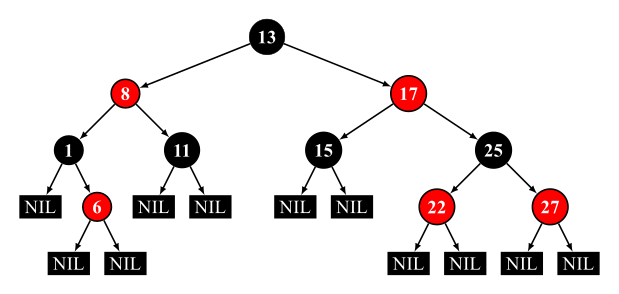
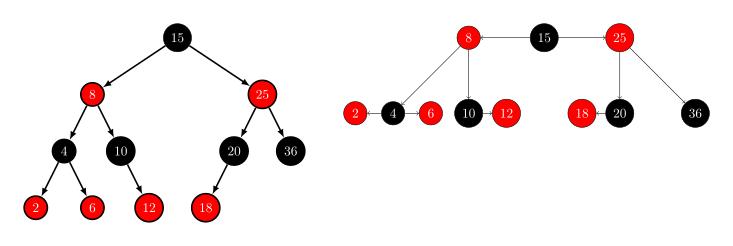
Some authors, e.g. Cormen & al.,2claim “the root is black” as fifth requirement; but not Mehlhorn & Sanders3or Sedgewick & Wayne.4Since the root can always be changed from red to black, this rule has little effect on analysis. This article also omits it, because it slightly disturbs the recursive algorithms and proofs.
红黑树类的定义
/** * An RBTree-based set implementation * * @tparam key_t key type * @tparam compare_t compare function */template <typename key_t, typename compare_t = std::less<key_t>>struct rb_tree { /** * Tree node */ struct node_t { node_t *fa; // == nullptr if root of the tree, otherwise parent node_t *ch[2]; // == nullptr if child is empty // ch[0]: left child, ch[1]: right child key_t data; size_t sz; // Size of subtree bool red; // == true if node is red, otherwise black /** * Get child direction of current non-null node * * @return true if this node is right child of its parent, otherwise false */ auto child_dir() const -> bool { return this == fa->ch[1]; } }; using pointer = node_t *; using const_pointer = const node_t *; using pointer_const = node_t *const; const compare_t compare; pointer root; rb_tree() : compare{}, root{nullptr} {} // ...};
  /**
   * @param p root of subtree (may be same as {@code root})
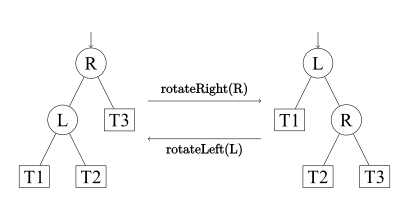
   * @param dir direction. 0: left rotate; 1: right rotate
   * @return new root of subtree
   */
  auto rotate(pointer p, bool dir) -> pointer {
    auto g = p->fa;
    auto s = p->ch[!dir];  // new root of subtree
    assert(s);             // pointer to true node required
    s->sz = p->sz, p->sz = size(p->ch[dir]) + size(s->ch[dir]) + 1;
    auto c = s->ch[dir];
    if (c) c->fa = p;
    p->ch[!dir] = c, s->ch[dir] = p;
    p->fa = s, s->fa = g;
    if (g)
      g->ch[p == g->ch[1]] = s;
    else
      root = s;
    return s;
  }
  /**
   * @return nullptr if insert failed, otherwise pointer of inserted node
   */
  auto insert(const key_t &data) -> const_pointer {
    pointer n = new node_t;
    n->fa = n->ch[0] = n->ch[1] = nullptr;
    n->data = data, n->sz = 1;
    pointer now = root, p = nullptr;
    bool dir = 0;
    while (now) {
      p = now;
      dir = compare(now->data, data);
      now = now->ch[dir];
    }
    insert_fixup_leaf(p, n, dir);
    return n;
  }
  /**
   * Insert leaf node {@code n} to {@code p}
   *
   * @param p parent of node which will be inserted
   * @param n leaf node which will be inserted
   * @param dir direction of n, 0: left; 1: right
   */
  void insert_leaf(pointer_const p, pointer_const n, bool dir) {
    if (!p) {
      root = n;
      return;
    }
    p->ch[dir] = n, n->fa = p;
    auto now = p;
    while (now) now->sz++, now = now->fa;
  }
  /**
   * Insert leaf node {@code n} to {@code p}, then fixup
   *
   * @param p parent of node which will be inserted
   * @param n node which will be inserted
   * @param dir direction of n, 0: left; 1: right
   */
  void insert_fixup_leaf(pointer p, pointer n, bool dir) {
    n->red = p;
    insert_leaf(p, n, dir);
    // Fix double red
    // ...
    // Post process: color root black
    root->red = false;
  }
插入后的平衡维护
Note
为加深理解,请读者自行验证平衡维护后是否满足性质 4。
由于插入的节点若不为根节点则必为红色,所以插入后可能违反性质 3,需要维护平衡性。
令插入的节点为 n,其父节点为 p,祖父节点为 g,叔节点为 u。由性质 3 可知 g 必为黑色。
我们从插入的位置开始向上递归维护,若 p 为黑色即可终止,否则分为 3 种情况。
    while (is_red(p = n->fa)) {
      bool p_dir = p->child_dir();
      auto g = p->fa, u = g->ch[!p_dir];
      // ...
    }
Insert case 1
p 和 u 均为红色。此时我们只需重新染色即可。
实现
      // Case 1: both p and u are red
      //      g              [g]
      //     / \             / \
      //   [p] [u]   ==>    p   u
      //   /               /
      // [n]             [n]
      if (is_red(u)) {
        p->red = u->red = false;
        g->red = true;
        n = g;
        continue;
      }
Insert case 2
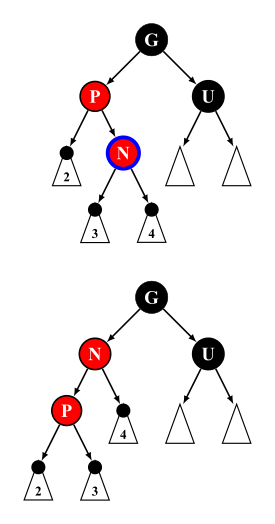
p 为红色,u 为黑色,p 的方向和 n 的方向不同。
此时我们需要旋转 p 节点来转为第三种情况。
实现
      // p is red and u is black
      // Case 2: dir of n is different with dir of p
      //    g              g
      //   / \            / \
      // [p]  u   ==>   [n]  u
      //   \            /
      //   [n]        [p]
      if (n->child_dir() != p_dir) rotate(p, p_dir), std::swap(n, p);
Insert case 3
p 为红色,u 为黑色,p 的方向和 n 的方向相同。
此时我们需要旋转 g 节点以将 p 转为子树的根,之后交换 p 和 g 的颜色即可。
实现
      // Case 3: p is red, u is black and dir of n is same as dir of p
      //      g             p
      //     / \           / \
      //   [p]  u   ==>  [n] [g]
      //   /                   \
      // [n]                    u
      p->red = false, g->red = true;
      rotate(g, !p_dir);
删除
红黑树的删除操作与普通的 BST 相比要多一些步骤。具体而言:
若待删除的节点 n 有两个子节点,则交换 n 和左子树中最大节点 s 的数据,并将 n 设为 s。此时 n 不可能有两个子节点。
若待删除的节点 n 有一个子节点 s。由性质 4 可知 s 必为红色,再由性质 3 可知 n 必为黑色。所以只需将 n 在父节点 p 中对应的指针替换为 s 的地址,以及将 s 的父节点指针替换为 p 的地址,之后再将 s 染黑即可。
若待删除的节点 n 没有子节点。若 n 是根节点或 n 是红色节点,则直接删除即可,否则直接删除会违反性质 4,需要维护平衡性。
实现
  /**
   * @return succeed or not
   */
  auto erase(const key_t &key) -> bool {
    auto p = lower_bound(key);
    if (!p || p->data != key) return false;
    erase(p);
    return true;
  }

  /**
   * @return {@code next(p)}
   */
  auto erase(pointer p) -> const_pointer {
    if (!p) return nullptr;
    pointer result;
    if (p->ch[0] && p->ch[1]) {
      auto s = leftmost(p->ch[1]);
      std::swap(s->data, p->data);
      result = p, p = s;
    } else
      result = next(p);
    erase_fixup_branch_or_leaf(p);
    delete p;
    return result;
  }
  /**
   * Erase node {@code n}
   *
   * @param n node which will be deleted, must have no more than 2 child
   */
  void erase_branch_or_leaf(pointer_const n) {
    auto p = n->fa, s = n->ch[0] ? n->ch[0] : n->ch[1];
    if (s) s->fa = p;
    if (!p) {
      root = s;
      return;
    }
    p->ch[n->child_dir()] = s;
    auto now = p;
    while (now) now->sz--, now = now->fa;
  }
  /**
   * Erase node {@code n}, then fixup
   *
   * @param n node which will be deleted, must have no more than 2 child
   */
  void erase_fixup_branch_or_leaf(pointer n) {
    bool n_dir = n == root ? false : n->child_dir();
    erase_branch_or_leaf(n);
    auto p = n->fa;
    if (!p) {  // n is root
      if (root) root->red = false;
      return;
    } else {
      auto s = p->ch[n_dir];
      if (s) {  // n has 1 child
        // n must be black and s must be red, so we need to color s black
        s->red = false;
        return;
      }
    }
    // n is not root but leaf with black color, need to be fixup
    // ...
    // Post process: see case 2 & case 4
    n->red = false;
  }
删除后的平衡维护
Note
为加深理解,请读者自行验证平衡维护后是否满足性质 4。
由上文讨论可知 n 是黑色叶子节点且不为根节点。我们设 n 的父节点为 p,兄弟节点为 s,侄节点分别为 c 和 d。
删除的维护也是从 n 开始向上递归维护,若 n 是根或 n 为红色即可终止,否则分为 4 种情况。
    while (p && !n->red) {
      auto s = p->ch[!n_dir];
      // Delete case 1
      // ...
      // Other cases
      // s must be black
      auto c = s->ch[n_dir], d = s->ch[!n_dir];
      // ...
    end_erase_fixup:
      p = n->fa;
      if (!p) break;
      n_dir = n->child_dir();
    }
Delete case 1
s 为红色。
此时我们旋转 p,将 s 转为子树根节点,之后交换 s 和 p 的颜色来转为其余三种情况之一。
实现
      // Case 1: s is red
      //    p               s
      //   / \             / \
      // |n| [s]   ==>   [p]  d
      //     / \         / \
      //    c   d      |n|  c
      if (is_red(s)) {
        s->red = false, p->red = true;
        rotate(p, n_dir);
        s = p->ch[!n_dir];
      }
Delete case 2
p 的颜色不确定,s、c、d 均为黑色。
此时只需将 s 染红即可。
需要注意的是,若 p 为红色则会违反性质 3,但是若 p 为红色则会直接退出循环,所以我们在最后将其染黑。
实现
      // Case 2: both c and d are black
      //   {p}          {p}
      //   / \          / \
      // |n|  s   ==> |n| [s]
      //     / \          / \
      //    c   d        c   d
      // p will be colored black in the end
      if (!is_red(c) && !is_red(d)) {
        s->red = true;
        n = p;
        goto end_erase_fixup;
      }
Delete case 3
p 的颜色不确定,s、d 均为黑色,c 为红色。
此时需要旋转 s 使 c 为原来 s 对应子树的根节点,并交换 s 和 c 的颜色转为第四种情况即可。
实现
      // Case 3: c is red and d is black
      //   {p}          {p}
      //   / \          / \
      // |n|  s   ==> |n|  c
      //     / \            \
      //   [c]  d           [s]
      //                      \
      //                       d
      if (!is_red(d)) {
        c->red = false, s->red = true;
        rotate(s, !n_dir);
        s = p->ch[!n_dir], c = s->ch[n_dir], d = s->ch[!n_dir];
      }
Delete case 4
p、c 的颜色不确定,s 为黑色,d 为红色。
此时需要旋转 p 使 s 为子树的根节点,交换 s 和 p 的颜色,并将 d 染黑即可终止维护平衡。
实现
      // Case 4: d is red
      //   {p}            {s}
      //   / \            / \
      // |n|  s   ==>    p   d
      //     / \        / \
      //   {c} [d]    |n| {c}
      s->red = p->red, p->red = d->red = false;
      rotate(p, n_dir), n = root;
参考代码
下面的代码是用红黑树实现的 set:
实现
/** * @file rbtree.hpp * @brief An RBTree-based set implementation * @details The set is sorted according to the {@code compare_t} function * provided; This implementation provides find, insert, remove, find order, find * key by order in O(log(n)) time. * @author [Tiphereth-A](https://github.com/Tiphereth-A) */#ifndef RBTREE_HPP#define RBTREE_HPP// --8<-- [start:class]#include <cassert>#include <cstdint>#include <functional>using std::size_t;// --8<-- [start:class-node1]/** * An RBTree-based set implementation * * @tparam key_t key type * @tparam compare_t compare function */template <typename key_t, typename compare_t = std::less<key_t>>struct rb_tree { /** * Tree node */ struct node_t { node_t *fa; // == nullptr if root of the tree, otherwise parent node_t *ch[2]; // == nullptr if child is empty // ch[0]: left child, ch[1]: right child key_t data; size_t sz; // Size of subtree bool red; // == true if node is red, otherwise black /** * Get child direction of current non-null node * * @return true if this node is right child of its parent, otherwise false */ auto child_dir() const -> bool { return this == fa->ch[1]; } }; using pointer = node_t *; using const_pointer = const node_t *; using pointer_const = node_t *const; const compare_t compare; pointer root; rb_tree() : compare{}, root{nullptr} {} // --8<-- [end:class-node1] ~rb_tree() { post_order([](auto it) { delete it; }); } auto size() const -> size_t { return size(root); } template <typename F> void pre_order(F callback) { auto f = [&](auto &&f, pointer p) { if (!p) return; callback(p), f(f, p->ch[0]), f(f, p->ch[1]); }; f(f, root); } template <typename F> void in_order(F callback) { auto f = [&](auto &&f, pointer p) { if (!p) return; f(f, p->ch[0]), callback(p), f(f, p->ch[1]); }; f(f, root); } template <typename F> void post_order(F callback) { auto f = [&](auto &&f, pointer p) { if (!p) return; f(f, p->ch[0]), f(f, p->ch[1]), callback(p); }; f(f, root); } auto leftmost(const_pointer p) const { return most(p, 0); } auto rightmost(const_pointer p) const { return most(p, 1); } auto prev(const_pointer p) const { return neighbour(p, 0); } auto next(const_pointer p) const { return neighbour(p, 1); } auto lower_bound(const key_t &key) const -> pointer { const_pointer now = root, ans = nullptr; while (now) { if (!compare(now->data, key)) ans = now, now = now->ch[0]; else now = now->ch[1]; } return (pointer)ans; } auto upper_bound(const key_t &key) const -> pointer { const_pointer now = root, ans = nullptr; while (now) { if (compare(key, now->data)) ans = now, now = now->ch[0]; else now = now->ch[1]; } return (pointer)ans; } // Order start from 0 auto order_of_key(const key_t &key) const -> size_t { size_t ans = 0; auto now = root; while (now) { if (!compare(now->data, key)) now = now->ch[0]; else ans += size(now->ch[0]) + 1, now = now->ch[1]; } return ans; } // Order start from 0 auto find_by_order(size_t order) const -> const_pointer { const_pointer now = root, ans = nullptr; while (now && now->sz >= order) { auto lsize = size(now->ch[0]); if (order < lsize) now = now->ch[0]; else { ans = now; if (order == lsize) break; now = now->ch[1], order -= lsize + 1; } } return ans; } // --8<-- [start:insert] /** * @return nullptr if insert failed, otherwise pointer of inserted node */ auto insert(const key_t &data) -> const_pointer { pointer n = new node_t; n->fa = n->ch[0] = n->ch[1] = nullptr; n->data = data, n->sz = 1; pointer now = root, p = nullptr; bool dir = 0; while (now) { p = now; dir = compare(now->data, data); now = now->ch[dir]; } insert_fixup_leaf(p, n, dir); return n; } // --8<-- [end:insert] // --8<-- [start:delete] /** * @return succeed or not */ auto erase(const key_t &key) -> bool { auto p = lower_bound(key); if (!p || p->data != key) return false; erase(p); return true; } /** * @return {@code next(p)} */ auto erase(pointer p) -> const_pointer { if (!p) return nullptr; pointer result; if (p->ch[0] && p->ch[1]) { auto s = leftmost(p->ch[1]); std::swap(s->data, p->data); result = p, p = s; } else result = next(p); erase_fixup_branch_or_leaf(p); delete p; return result; } // --8<-- [end:delete] private: static auto size(const_pointer p) -> size_t { return p ? p->sz : 0; } static auto is_red(const_pointer p) -> bool { return p ? p->red : false; } /** * @param dir 0: leftmost, 1: rightmost */ auto most(const_pointer p, bool dir) const -> pointer { if (!p) return nullptr; while (p->ch[dir]) p = p->ch[dir]; return (pointer)p; } /** * @param dir 0: prev, 1: next */ auto neighbour(const_pointer p, bool dir) const -> pointer { if (!p) return nullptr; if (p->ch[dir]) return most(p->ch[dir], !dir); if (p == root) return nullptr; while (p && p->fa && p->child_dir() == dir) p = p->fa; return p ? p->fa : nullptr; } // --8<-- [start:insert-leaf] /** * Insert leaf node {@code n} to {@code p} * * @param p parent of node which will be inserted * @param n leaf node which will be inserted * @param dir direction of n, 0: left; 1: right */ void insert_leaf(pointer_const p, pointer_const n, bool dir) { if (!p) { root = n; return; } p->ch[dir] = n, n->fa = p; auto now = p; while (now) now->sz++, now = now->fa; } // --8<-- [end:insert-leaf] // --8<-- [start:delete-leaf] /** * Erase node {@code n} * * @param n node which will be deleted, must have no more than 2 child */ void erase_branch_or_leaf(pointer_const n) { auto p = n->fa, s = n->ch[0] ? n->ch[0] : n->ch[1]; if (s) s->fa = p; if (!p) { root = s; return; } p->ch[n->child_dir()] = s; auto now = p; while (now) now->sz--, now = now->fa; } // --8<-- [end:delete-leaf] // --8<-- [start:rotate] /** * @param p root of subtree (may be same as {@code root}) * @param dir direction. 0: left rotate; 1: right rotate * @return new root of subtree */ auto rotate(pointer p, bool dir) -> pointer { auto g = p->fa; auto s = p->ch[!dir]; // new root of subtree assert(s); // pointer to true node required s->sz = p->sz, p->sz = size(p->ch[dir]) + size(s->ch[dir]) + 1; auto c = s->ch[dir]; if (c) c->fa = p; p->ch[!dir] = c, s->ch[dir] = p; p->fa = s, s->fa = g; if (g) g->ch[p == g->ch[1]] = s; else root = s; return s; } // --8<-- [end:rotate]#pragma GCC diagnostic ignored "-Wcomment" // --8<-- [start:insert-fixup1] /** * Insert leaf node {@code n} to {@code p}, then fixup * * @param p parent of node which will be inserted * @param n node which will be inserted * @param dir direction of n, 0: left; 1: right */ void insert_fixup_leaf(pointer p, pointer n, bool dir) { n->red = p; insert_leaf(p, n, dir); // Fix double red // --8<-- [end:insert-fixup1] // --8<-- [start:insert-aux1] while (is_red(p = n->fa)) { bool p_dir = p->child_dir(); auto g = p->fa, u = g->ch[!p_dir]; // --8<-- [end:insert-aux1] // --8<-- [start:insert-case1] // Case 1: both p and u are red // g [g] // / \ / \ // [p] [u] ==> p u // / / // [n] [n] if (is_red(u)) { p->red = u->red = false; g->red = true; n = g; continue; } // --8<-- [end:insert-case1] // --8<-- [start:insert-case2] // p is red and u is black // Case 2: dir of n is different with dir of p // g g // / \ / \ // [p] u ==> [n] u // \ / // [n] [p] if (n->child_dir() != p_dir) rotate(p, p_dir), std::swap(n, p); // --8<-- [end:insert-case2] // --8<-- [start:insert-case3] // Case 3: p is red, u is black and dir of n is same as dir of p // g p // / \ / \ // [p] u ==> [n] [g] // / \ // [n] u p->red = false, g->red = true; rotate(g, !p_dir); // --8<-- [end:insert-case3] // --8<-- [start:insert-aux2] } // --8<-- [end:insert-aux2] // --8<-- [start:insert-fixup2] // Post process: color root black root->red = false; } // --8<-- [end:insert-fixup2] // --8<-- [start:delete-fixup1] /** * Erase node {@code n}, then fixup * * @param n node which will be deleted, must have no more than 2 child */ void erase_fixup_branch_or_leaf(pointer n) { bool n_dir = n == root ? false : n->child_dir(); erase_branch_or_leaf(n); auto p = n->fa; if (!p) { // n is root if (root) root->red = false; return; } else { auto s = p->ch[n_dir]; if (s) { // n has 1 child // n must be black and s must be red, so we need to color s black s->red = false; return; } } // n is not root but leaf with black color, need to be fixup // --8<-- [end:delete-fixup1] // --8<-- [start:delete-aux1] while (p && !n->red) { auto s = p->ch[!n_dir]; // --8<-- [end:delete-aux1] // --8<-- [start:delete-case1] // Case 1: s is red // p s // / \ / \ // |n| [s] ==> [p] d // / \ / \ // c d |n| c if (is_red(s)) { s->red = false, p->red = true; rotate(p, n_dir); s = p->ch[!n_dir]; } // --8<-- [end:delete-case1] // --8<-- [start:delete-aux2] // s must be black auto c = s->ch[n_dir], d = s->ch[!n_dir]; // --8<-- [end:delete-aux2] // --8<-- [start:delete-case2] // Case 2: both c and d are black // {p} {p} // / \ / \ // |n| s ==> |n| [s] // / \ / \ // c d c d // p will be colored black in the end if (!is_red(c) && !is_red(d)) { s->red = true; n = p; goto end_erase_fixup; } // --8<-- [end:delete-case2] // --8<-- [start:delete-case3] // Case 3: c is red and d is black // {p} {p} // / \ / \ // |n| s ==> |n| c // / \ \ // [c] d [s] // \ // d if (!is_red(d)) { c->red = false, s->red = true; rotate(s, !n_dir); s = p->ch[!n_dir], c = s->ch[n_dir], d = s->ch[!n_dir]; } // --8<-- [end:delete-case3] // --8<-- [start:delete-case4] // Case 4: d is red // {p} {s} // / \ / \ // |n| s ==> p d // / \ / \ // {c} [d] |n| {c} s->red = p->red, p->red = d->red = false; rotate(p, n_dir), n = root; // --8<-- [end:delete-case4] // --8<-- [start:delete-aux3] end_erase_fixup: p = n->fa; if (!p) break; n_dir = n->child_dir(); } // --8<-- [end:delete-aux3] // --8<-- [start:delete-fixup2] // Post process: see case 2 & case 4 n->red = false; } // --8<-- [end:delete-fixup2] // --8<-- [start:class-node2]};// --8<-- [end:class-node2]#pragma GCC diagnostic warning "-Wcomment"// --8<-- [end:class]#endif // RBTREE_HPP
#include <cassert>#include <cstdint>#include <functional>using std::size_t;// --8<-- [start:class-node1]/** * An RBTree-based set implementation * * @tparam key_t key type * @tparam compare_t compare function */template <typename key_t, typename compare_t = std::less<key_t>>struct rb_tree { /** * Tree node */ struct node_t { node_t *fa; // == nullptr if root of the tree, otherwise parent node_t *ch[2]; // == nullptr if child is empty // ch[0]: left child, ch[1]: right child key_t data; size_t sz; // Size of subtree bool red; // == true if node is red, otherwise black /** * Get child direction of current non-null node * * @return true if this node is right child of its parent, otherwise false */ auto child_dir() const -> bool { return this == fa->ch[1]; } }; using pointer = node_t *; using const_pointer = const node_t *; using pointer_const = node_t *const; const compare_t compare; pointer root; rb_tree() : compare{}, root{nullptr} {} // --8<-- [end:class-node1] ~rb_tree() { post_order([](auto it) { delete it; }); } auto size() const -> size_t { return size(root); } template <typename F> void pre_order(F callback) { auto f = [&](auto &&f, pointer p) { if (!p) return; callback(p), f(f, p->ch[0]), f(f, p->ch[1]); }; f(f, root); } template <typename F> void in_order(F callback) { auto f = [&](auto &&f, pointer p) { if (!p) return; f(f, p->ch[0]), callback(p), f(f, p->ch[1]); }; f(f, root); } template <typename F> void post_order(F callback) { auto f = [&](auto &&f, pointer p) { if (!p) return; f(f, p->ch[0]), f(f, p->ch[1]), callback(p); }; f(f, root); } auto leftmost(const_pointer p) const { return most(p, 0); } auto rightmost(const_pointer p) const { return most(p, 1); } auto prev(const_pointer p) const { return neighbour(p, 0); } auto next(const_pointer p) const { return neighbour(p, 1); } auto lower_bound(const key_t &key) const -> pointer { const_pointer now = root, ans = nullptr; while (now) { if (!compare(now->data, key)) ans = now, now = now->ch[0]; else now = now->ch[1]; } return (pointer)ans; } auto upper_bound(const key_t &key) const -> pointer { const_pointer now = root, ans = nullptr; while (now) { if (compare(key, now->data)) ans = now, now = now->ch[0]; else now = now->ch[1]; } return (pointer)ans; } // Order start from 0 auto order_of_key(const key_t &key) const -> size_t { size_t ans = 0; auto now = root; while (now) { if (!compare(now->data, key)) now = now->ch[0]; else ans += size(now->ch[0]) + 1, now = now->ch[1]; } return ans; } // Order start from 0 auto find_by_order(size_t order) const -> const_pointer { const_pointer now = root, ans = nullptr; while (now && now->sz >= order) { auto lsize = size(now->ch[0]); if (order < lsize) now = now->ch[0]; else { ans = now; if (order == lsize) break; now = now->ch[1], order -= lsize + 1; } } return ans; } // --8<-- [start:insert] /** * @return nullptr if insert failed, otherwise pointer of inserted node */ auto insert(const key_t &data) -> const_pointer { pointer n = new node_t; n->fa = n->ch[0] = n->ch[1] = nullptr; n->data = data, n->sz = 1; pointer now = root, p = nullptr; bool dir = 0; while (now) { p = now; dir = compare(now->data, data); now = now->ch[dir]; } insert_fixup_leaf(p, n, dir); return n; } // --8<-- [end:insert] // --8<-- [start:delete] /** * @return succeed or not */ auto erase(const key_t &key) -> bool { auto p = lower_bound(key); if (!p || p->data != key) return false; erase(p); return true; } /** * @return {@code next(p)} */ auto erase(pointer p) -> const_pointer { if (!p) return nullptr; pointer result; if (p->ch[0] && p->ch[1]) { auto s = leftmost(p->ch[1]); std::swap(s->data, p->data); result = p, p = s; } else result = next(p); erase_fixup_branch_or_leaf(p); delete p; return result; } // --8<-- [end:delete] private: static auto size(const_pointer p) -> size_t { return p ? p->sz : 0; } static auto is_red(const_pointer p) -> bool { return p ? p->red : false; } /** * @param dir 0: leftmost, 1: rightmost */ auto most(const_pointer p, bool dir) const -> pointer { if (!p) return nullptr; while (p->ch[dir]) p = p->ch[dir]; return (pointer)p; } /** * @param dir 0: prev, 1: next */ auto neighbour(const_pointer p, bool dir) const -> pointer { if (!p) return nullptr; if (p->ch[dir]) return most(p->ch[dir], !dir); if (p == root) return nullptr; while (p && p->fa && p->child_dir() == dir) p = p->fa; return p ? p->fa : nullptr; } // --8<-- [start:insert-leaf] /** * Insert leaf node {@code n} to {@code p} * * @param p parent of node which will be inserted * @param n leaf node which will be inserted * @param dir direction of n, 0: left; 1: right */ void insert_leaf(pointer_const p, pointer_const n, bool dir) { if (!p) { root = n; return; } p->ch[dir] = n, n->fa = p; auto now = p; while (now) now->sz++, now = now->fa; } // --8<-- [end:insert-leaf] // --8<-- [start:delete-leaf] /** * Erase node {@code n} * * @param n node which will be deleted, must have no more than 2 child */ void erase_branch_or_leaf(pointer_const n) { auto p = n->fa, s = n->ch[0] ? n->ch[0] : n->ch[1]; if (s) s->fa = p; if (!p) { root = s; return; } p->ch[n->child_dir()] = s; auto now = p; while (now) now->sz--, now = now->fa; } // --8<-- [end:delete-leaf] // --8<-- [start:rotate] /** * @param p root of subtree (may be same as {@code root}) * @param dir direction. 0: left rotate; 1: right rotate * @return new root of subtree */ auto rotate(pointer p, bool dir) -> pointer { auto g = p->fa; auto s = p->ch[!dir]; // new root of subtree assert(s); // pointer to true node required s->sz = p->sz, p->sz = size(p->ch[dir]) + size(s->ch[dir]) + 1; auto c = s->ch[dir]; if (c) c->fa = p; p->ch[!dir] = c, s->ch[dir] = p; p->fa = s, s->fa = g; if (g) g->ch[p == g->ch[1]] = s; else root = s; return s; } // --8<-- [end:rotate]#pragma GCC diagnostic ignored "-Wcomment" // --8<-- [start:insert-fixup1] /** * Insert leaf node {@code n} to {@code p}, then fixup * * @param p parent of node which will be inserted * @param n node which will be inserted * @param dir direction of n, 0: left; 1: right */ void insert_fixup_leaf(pointer p, pointer n, bool dir) { n->red = p; insert_leaf(p, n, dir); // Fix double red // --8<-- [end:insert-fixup1] // --8<-- [start:insert-aux1] while (is_red(p = n->fa)) { bool p_dir = p->child_dir(); auto g = p->fa, u = g->ch[!p_dir]; // --8<-- [end:insert-aux1] // --8<-- [start:insert-case1] // Case 1: both p and u are red // g [g] // / \ / \ // [p] [u] ==> p u // / / // [n] [n] if (is_red(u)) { p->red = u->red = false; g->red = true; n = g; continue; } // --8<-- [end:insert-case1] // --8<-- [start:insert-case2] // p is red and u is black // Case 2: dir of n is different with dir of p // g g // / \ / \ // [p] u ==> [n] u // \ / // [n] [p] if (n->child_dir() != p_dir) rotate(p, p_dir), std::swap(n, p); // --8<-- [end:insert-case2] // --8<-- [start:insert-case3] // Case 3: p is red, u is black and dir of n is same as dir of p // g p // / \ / \ // [p] u ==> [n] [g] // / \ // [n] u p->red = false, g->red = true; rotate(g, !p_dir); // --8<-- [end:insert-case3] // --8<-- [start:insert-aux2] } // --8<-- [end:insert-aux2] // --8<-- [start:insert-fixup2] // Post process: color root black root->red = false; } // --8<-- [end:insert-fixup2] // --8<-- [start:delete-fixup1] /** * Erase node {@code n}, then fixup * * @param n node which will be deleted, must have no more than 2 child */ void erase_fixup_branch_or_leaf(pointer n) { bool n_dir = n == root ? false : n->child_dir(); erase_branch_or_leaf(n); auto p = n->fa; if (!p) { // n is root if (root) root->red = false; return; } else { auto s = p->ch[n_dir]; if (s) { // n has 1 child // n must be black and s must be red, so we need to color s black s->red = false; return; } } // n is not root but leaf with black color, need to be fixup // --8<-- [end:delete-fixup1] // --8<-- [start:delete-aux1] while (p && !n->red) { auto s = p->ch[!n_dir]; // --8<-- [end:delete-aux1] // --8<-- [start:delete-case1] // Case 1: s is red // p s // / \ / \ // |n| [s] ==> [p] d // / \ / \ // c d |n| c if (is_red(s)) { s->red = false, p->red = true; rotate(p, n_dir); s = p->ch[!n_dir]; } // --8<-- [end:delete-case1] // --8<-- [start:delete-aux2] // s must be black auto c = s->ch[n_dir], d = s->ch[!n_dir]; // --8<-- [end:delete-aux2] // --8<-- [start:delete-case2] // Case 2: both c and d are black // {p} {p} // / \ / \ // |n| s ==> |n| [s] // / \ / \ // c d c d // p will be colored black in the end if (!is_red(c) && !is_red(d)) { s->red = true; n = p; goto end_erase_fixup; } // --8<-- [end:delete-case2] // --8<-- [start:delete-case3] // Case 3: c is red and d is black // {p} {p} // / \ / \ // |n| s ==> |n| c // / \ \ // [c] d [s] // \ // d if (!is_red(d)) { c->red = false, s->red = true; rotate(s, !n_dir); s = p->ch[!n_dir], c = s->ch[n_dir], d = s->ch[!n_dir]; } // --8<-- [end:delete-case3] // --8<-- [start:delete-case4] // Case 4: d is red // {p} {s} // / \ / \ // |n| s ==> p d // / \ / \ // {c} [d] |n| {c} s->red = p->red, p->red = d->red = false; rotate(p, n_dir), n = root; // --8<-- [end:delete-case4] // --8<-- [start:delete-aux3] end_erase_fixup: p = n->fa; if (!p) break; n_dir = n->child_dir(); } // --8<-- [end:delete-aux3] // --8<-- [start:delete-fixup2] // Post process: see case 2 & case 4 n->red = false; } // --8<-- [end:delete-fixup2] // --8<-- [start:class-node2]};// --8<-- [end:class-node2]#pragma GCC diagnostic warning "-Wcomment"#include <iostream>#include <numeric>#include <vector>template <bool P6136> // == false: P3369, == true: P6136struct IO_luogu_P3369_P6136 { int last_ans = 0; std::size_t n, m; std::vector<int> a; std::vector<int> ans_list; void init() { std::cin >> n; if (!P6136) { m = n; return; } std::cin >> m; a.resize(n); for (auto &i : a) std::cin >> i; } int opt() { int x; std::cin >> x; return x; } int x() { int x; std::cin >> x; return P6136 ? x ^ last_ans : x; } void print(int ans) { ans_list.push_back(last_ans = ans); } void print_total_ans() { if (P6136) std::cout << std::accumulate(ans_list.begin(), ans_list.end(), 0, std::bit_xor<int>{}) << '\n'; else for (auto &&i : ans_list) std::cout << i << '\n'; }};// 把这里的模板参数改为 false 即为「Luogu P3369【模板】普通平衡树」的代码IO_luogu_P3369_P6136<true> io;int main() { std::cin.tie(nullptr)->sync_with_stdio(false); io.init(); std::size_t n = io.n, m = io.m; rb_tree<std::pair<int, int>> bt; int cnt = 0; for (auto i : io.a) bt.insert(std::make_pair(i, cnt++)); for (int i = 0, opt, x; (std::size_t)i < m; ++i) { opt = io.opt(), x = io.x(); switch (opt) { case 1: bt.insert({x, cnt++}); break; case 2: bt.erase(bt.lower_bound({x, 0})); break; case 3: io.print((int)bt.order_of_key({x, 0}) + 1); break; case 4: io.print(bt.find_by_order((uint32_t)x - 1)->data.first); break; case 6: io.print(bt.upper_bound({x, n + m})->data.first); break; case 5: auto it = bt.lower_bound({x, 0}); io.print((it ? bt.prev(it) : bt.rightmost(bt.root))->data.first); break; } } io.print_total_ans(); return 0;}
与 2-3-4 树的关系
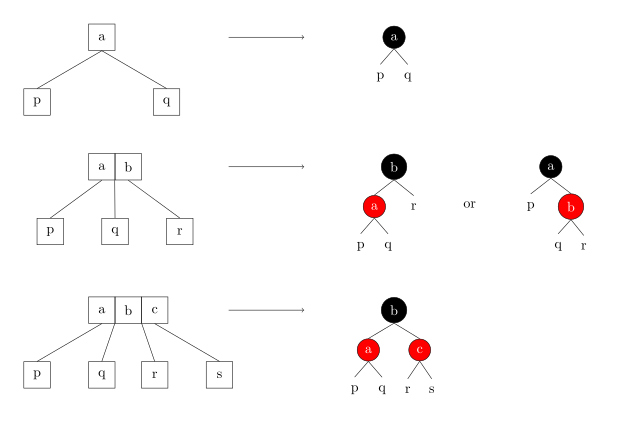
2-3-4 树是 4 阶 B 树,与一般的 B 树一样,2-3-4 树可以实现在 O(logn) 时间内进行搜索、插入和删除操作。2-3-4 树的节点分为三种,2 节点、3 节点和 4 节点,分别包含一个、两个或三个数据元素。所有的叶子节点都处于同一深度(最底层),所有数据都有序存储。
Linux 的稳定内核版本在 2.6.24 之后,使用了新的调度程序 CFS,所有非实时可运行进程都以虚拟运行时间为键值用一棵红黑树进行维护,以完成更公平高效地调度所有任务。CFS 弃用 active/expired 数组和动态计算优先级,不再跟踪任务的睡眠时间和区别是否交互任务,而是在调度中采用基于时间计算键值的红黑树来选取下一个任务,根据所有任务占用 CPU 时间的状态来确定调度任务优先级。
L. J. Guibas and R. Sedgewick, “A dichromatic framework for balanced trees,“19th Annual Symposium on Foundations of Computer Science (sfcs 1978), Ann Arbor, MI, USA, 1978, pp. 8-21, doi:10.1109/SFCS.1978.3. ↩